
- “Only image formed keeps the
vision.
Yet image formed rests in the poem”
(Martin Heidegger)
In the process of the film it is suggested that Terence Malick investigates and animates a series of fundamental Heideggerian philosophical themes. The theatre of war establishes a framework within which it is possible to enact philosophical exercises and examine in a lucid, yet simultaneously poetic and aesthetic manner, issues that parallel the actions that structure Heidegger’s writing.
 The
film begins with a perspective-altering monologue. An AWOL soldier Pvt
Witt is firstly located among native villagers with a series of scenes
invoking “an alternative”- a way out of war. However, this
is subsequently contrasted with a different vision - a narrative line that
pursues a far darker trajectory - Witt is incarcerated in the prison section
of a battleship, interrogated by 1st Sgt Edward Welsh who maintains “there
ain’t no world but this one”. Malick’s vision of World War II is
arranged poetically rather than narratively and centred around repeated
meditative sequences reflecting upon notions of life and death, war and
violence, good and evil, the nature of the human condition, and ultimately
existence and nature.
The
film begins with a perspective-altering monologue. An AWOL soldier Pvt
Witt is firstly located among native villagers with a series of scenes
invoking “an alternative”- a way out of war. However, this
is subsequently contrasted with a different vision - a narrative line that
pursues a far darker trajectory - Witt is incarcerated in the prison section
of a battleship, interrogated by 1st Sgt Edward Welsh who maintains “there
ain’t no world but this one”. Malick’s vision of World War II is
arranged poetically rather than narratively and centred around repeated
meditative sequences reflecting upon notions of life and death, war and
violence, good and evil, the nature of the human condition, and ultimately
existence and nature.
The Thin Red Line is a dream-like
epic, an elliptical, episodic film, dependent on images and reveries.
The Thin Red Line is a narrative
related in fragments and passages, in glimpses of action. The film’s
concerns are philosophical rather than principally dramatic, and its extensive
voice-over treatments deal not with story lines but with ruminations of
how to exist in a world described as “blowing itself to hell as fast as
anyone can arrange it”.
“This great evil, where does it come from, how did it steal into the world?”
“How did we lose the good that was given us?”
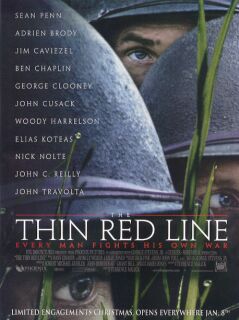 The
film presents a juxtaposition of vicious mechanised battles taking place
in a pristine wilderness, where forces of destruction collide with a people
living in quite harmony within their environment (these were the Melanesians
of the Solomon Islands, whose way of life centres on family, tribe and
tranquillity). The film opens with bucolic sequences, - images of
an unspoiled Eden are contrasted with the horrors created by a nominally
more “advanced” civilization.
The
film presents a juxtaposition of vicious mechanised battles taking place
in a pristine wilderness, where forces of destruction collide with a people
living in quite harmony within their environment (these were the Melanesians
of the Solomon Islands, whose way of life centres on family, tribe and
tranquillity). The film opens with bucolic sequences, - images of
an unspoiled Eden are contrasted with the horrors created by a nominally
more “advanced” civilization.
The films themes are articulated via a series of different voice-overs - these individual reactions and perceptions become essential touchstones in the chaotic miasma that Malick conjures. Malick is clearly concerned with the complex emotions and unanswerable questions that arise when humans are directly confronted with the dualistic nature of existence/being.
The profundity of Witt’s thoughts - voiced through short passages of prayer-like spoken narrative (as are those of Welsh, Pvt Bell and Colonel Tall) - become the discernible context for the film’s violent actions. More accurately those thoughts find their resonance in Malick’s omniscient perspective, in the way he regards the natural environment as unquestioningly deterministic while, in contrast, no human can appear to be detached from the phenomenon of violence without losing his essential humanity.
The architecturally circular structure of The Thin Red Line parallels the fundamentals of Heideggerian thinking. Heidegger’s work must be understood as a Way, one that never comes to an end but pursues an essentially restless passage. Each resting place is inevitably unstable and what would appear to be a conclusion becomes a departure point for a renewed questioning. Precisely to put the foundation of any thinking itself in question.
By principally invoking the notion of death Malick, tracing the line of Heideggerian thought, (1) suggests that superficially death is not simply or even primarily something that occurs at the end of life. ‘Dasein’s’ awareness that it will die at any moment, means that “dying”, its attitude to or “being towards” it’s own death, pervades and shapes its whole life. ‘Dasein’ cannot render a complete account of itself without death because it is death that shadows every moment of ‘Dasein’s’ life. Death separates the authentic from the inauthentic. This is located in notions of individuality. The inauthentic is lost in the absurdity of the “they”; “they” obscure the ever-present possibility of my “own” death. Authenticity is derived from a constant awareness of the possibility of one’s death. One sees the situation and the possibilities and therefore makes decisions, (in the light of the awareness). Awareness of one’s own death promotes “one” above the “they” since ‘Dasein’ must die its own - dying is not a joint/communal enterprise - death “lays claims to it as an “individual - Dasein……individualizes Dasein down to itself” (Being and Time). This confers on ‘Dasein’ a particular type of freedom, “freedom towards death” (Being and Time). What Heidegger suggests is that taking seriously the prospect of your own death forces you to consider the relations to which others importantly matter to “yourself”. You cannot reside in the inauthenticity of the “they”, (with fallen comrades), simply because that is the given. Dying individualizes ‘Dasein‘: In a way, it is only in dying that I can say absolutely “I am”. (History of the Concept of Time: Prolegomena).
‘Dasein’ proceeds ahead towards it’s own termination, in this is eludes the “they” and makes an authentic choice about it’s own way of being, not simply accepting the established/limited range of possibilities afforded by “them”. It is the residual awareness of the authentic self that enables ‘Dasein’ to call to itself in conscience and at certain times respond to that call from conscience. The call of conscience therefore reveals to Dasein that it is guilty. Authentic ‘Dasein’ realises its guilt and acts in accordance of that awareness. ‘Dasein’ makes a choice, choosing for itself a way of being. “We define the formal existential idea of the “Guilty” as: Being - the - basis for a Being, which has, been defined by a “not” - that is, as Being-the-basis of a nullity”. (Being and Time).
Avoiding the endgame of nullity, authentic ‘Dasein’ becomes resolute, “entschlossen” “Resoluteness (Entschlossenheit) is a distinctive mode of ‘Dasein’s’ disclosedness (Erschlossenheit) Being and Time). Resoluteness confers upon ‘Dasein’s’ decisions a fateful necessity despite the nullity of its projection. In resoluteness ‘Dasein’ draws itself together as well as opening itself out.
When confronted with momentous choices, a concrete moral code is of little use - either it gives no unequivocal answer to a problem or it is itself open to question. An “ethic” is of little use either. It too leaves the matter undecided. Heidegger’s attitude to fundamental choices is similar to his view of truth. There is no truth in the sense of correspondence to the facts, nor are there, in the most fundamental cases, any definable criteria for deciding whether a view is true or not. The best one can do is be “primordial” - go back as far as possible towards the source, disregarding contemporary/superficial judgement concurrent with the “they”.
There are no objectively correct answers to life’s basic problems nor any decision procedure for discerning them. The best one can do is be resolute - withdraw from the crowd - and enact a decision based on one’s view as a whole. The advantage of resolute ‘Dasein’ is that it discloses itself, its possibilities, and its possibilities, and its wholeness, in a way that it’s irresolute manifestation does not. We need to look to resolute ‘Dasein’ to view the essential complexion of ‘Dasein’ (irresolute/inauthentic ‘Dasein’ cannot render an adequate interpretation of its own condition or of resoluteness).
It is only the resolute that can give an accurate account of irresoluteness/resoluteness. One must distance oneself from the current condition - run ahead of one’s own death and return to the past, seek the source…..”the research which wants to develop and conceptualise that kind of Being which belongs to existence, is itself a kind of Being which disclosive ‘Dasein’ possesses; can such research be denied this projecting which is essential to ‘Dasein?’ (Being and Time).
Malick’s imagery in The Thin Red Line aims at our “Being”. It wrestles with complexity, speaks to us in poetic aphorisms and weaves together multiple narrative strands. Its conceptual nature and malleability are an important part of its identity. Malick offers a magnificent vision of a soulful quest - in the presence of misery and fear - for a meaning to the human condition.
As Heidegger would have suggested, it is in the poetic form that we are less disposed to manipulate things or reduce them to our own technical/scientific, quantitative frames of reference; we are encouraged to let things be what they are and in this show their many-sidedness.
The film’s sequencing is organised within a Heideggerian structure. Elements are not presented as a series of homogeneous instants with significance conferred upon them by the protagonist’s resolution. The complex is not composite. It is not constructed from a combination of simple components, and it cannot be interpreted as if it were. Historically, time, or at least the experience of time, did not first enter the world as a simple now -sequence; it first arose as the time of resolute ‘Dasein‘, ‘Dasein’ striving to impose order/significance on an apparently hostile environment.
Resolute ‘Dasein’ runs ahead to its death, it stretches back into the past, before deciding how to act in the present - the authentic present (Augenblick) - the moment of vision. “Dasein exists as born; and, as born, it is already dying, in the sense of Being - towards - death. As long as Dasein factually exists, both the “ends” and their “between” are.” (Being and Time)
‘Dasein’ runs ahead to its own death
and then “comes towards itself” out of the future. It does not simply
return to the present. It recoils from the future, from its own death,
back into the past. This is a past that is not inert but exists actively
in the present - a past that informs the present and influences possibilities.
‘Dasein’ comes back out of the past into the present (Gegenwart) and there
decides upon action.
“Only as the Present in the sense of
making present, can resoluteness be what it is; namely, letting itself
be encountered undisguised by that which it seizes upon in taking action”.
(Being and Time).
‘Dasein’ has the ability, at any moment to traverse its complete existence - to run ahead to its own death, return to its birth, and rebound into the present - and this makes it a unified self. ‘Dasein’ can be said to transcend other entities, and project, a world in which they lie at a critical distance from ‘Dasein’ itself. In this respect ‘Dasein’ is finite, it exists among the beings which it allows to be themselves, it encounters rather than creates. Dasein can choose its “being with” how, in what capacity and what it encounters. ‘Dasein’ navigates a passage between realism and idealism - it is “in between” - between birth and death, between itself and the world. ‘Dasein’ transcends to world and ‘Dasein’ transcends in temporality. ‘Dasein’ transcends temporally if, and only if, it transcends to world.
Circumstances/events presuppose ‘Dasein’s’ freedom. It is ‘Dasein’s’ freedom and transcendence that facilitates, indeed requires, it to survey entities as possibilities rather than actualities. Therefore ‘Dasein’ essentially asks “Why?” ‘Dasein’ examines any particular being as a possibility and asks for its ground and/or the ground for/of all beings together; “Why is there anything at all rather than nothing?”
To enable unconcealment to “show itself” - this is the most succinct formulation of the task of Heideggerian thought. At the centre of this is the question of “freedom” - a freedom that refers us to the notion of 'Dasein' as transcendence. The task requires us to think historically (an “essential unfolding”).
Malick’s vision is characterized by crystalline images and a facility for camera movement so fluid as to appear “thought - activated”. The Thin Red Line concentrates on an ambiguous metaphorical shot sequencing. A poetic surrealism encompasses the films depiction of combat. It is the sense of dislocation that Malick emphasises, the mind-distorting vacancy and absolute essential “horror” of conflict. The film masterfully dictates emotional violence, through event/editing/music in each segment - the cumulative suggestive visual and aural images construct a supreme experience.
Heidegger suggested in a collection
of essays entitled “Holzwege” (wood paths/timber tracks) images that animated
the structure of his thinking, reflecting the linearity of the way with
the flexibility of a constant renewal of inquiry.
- “Wood is an old name for forest.
In the wood are paths that mostly wind along until they end in an impenetrable
thicket.
They are called “woodpaths”
Each goes its peculiar way, but in the same forest. Often it seems as though one were identical to another. Yet it only seems so.
Woodcutters and foresters are familiar with these paths. They know what it means to be on a woodpath”
(Holzwege)
“Sein” and “alethepia”, the coming to and departing from presence that is to say, to and from the clearing of unconcealment, occur at each turn of the path. “Holzwege” wend every which way.
For Malick the thought patterns that characterise The Thin Red Line are participation’s in the creative struggle of the world and earth. They reveal beings and let them come to radiant appearance, however only by cultivating and maintaining their provenance, allowing all things the darkness they require and space of articulation. In all its work the structured thought aesthetics of the film encompasses the splendours that come to light.
In the culmination of his investigations, Heidegger considers thought on the free and open spaces where things appear, linger, endure and disappear - “die Lichtung des Seins” (the clearing of Being). Heidegger is proposing a designated and unencumbered location for the presenting of Being/things - the lighting of Being, the opening that precedes all natural and divine light. This is what Heidegger designates “the task of thinking” Thinking must pursue the mystery of the clearing - the necessity of unconcealment for self-concealing, the need for self-showing or upsurgence for reticence or hiding, the need of gathering for sheltering - protect the interplay of unconcealment and concealment in the “Lichting des Seins”.
 What
ultimately concerns Malick in his promotion of lines of Heideggrian thinking
is to address, construct, examine, create become attuned to; to animate
and illuminate the ways humans involve themselves with “Being” as a whole.
For humans are among the beings that for the time being are. It is
the question of Being that proves vital for the recovery of the opportunities
to ask what is happening with the condition of humanity on this earth,
to nurture an awareness of the possibilities and consequences implied in
the essential words “am”, “are”, “is”, since Being can be said of all beings
and in a multitude of senses, although always with a view to the one.
What
ultimately concerns Malick in his promotion of lines of Heideggrian thinking
is to address, construct, examine, create become attuned to; to animate
and illuminate the ways humans involve themselves with “Being” as a whole.
For humans are among the beings that for the time being are. It is
the question of Being that proves vital for the recovery of the opportunities
to ask what is happening with the condition of humanity on this earth,
to nurture an awareness of the possibilities and consequences implied in
the essential words “am”, “are”, “is”, since Being can be said of all beings
and in a multitude of senses, although always with a view to the one.
Footnotes
1. Heigeggerian thought circles around a double theme - the meaning of Being and the propriative event (“Ereignis”) of disclosure. “Sein” and “aletheia” are the main words - “Sein” meaning coming to presence and “aletheia” the disclosedness or unconcealment implied in such presence. This conversely has its reverse. Coming to presence suggests an absence before and after, therefore withdrawal and departure are always thought in conjunction with “Sein” as presencing - disclosedness / unconcealment suggests a surrounding obscurity, so that darkness and oblivion are considered as being together with “aletheia”. The propriative event is always simultaneously expropriative (“Enteignis”)
Copyright A. Gargett (PhD)
|
|